At Walt Disney World, biometric measurements are taken from the fingers of guests to ensure that the person's ticket is used by the same person from day to day
- For the use of statistics in biology, see Biostatistics.
Biometrics (ancient Greek: bios ="life", metron ="measure") is the study of methods for uniquely recognizing humans based upon one or more intrinsic physical or behavioral traits.
Some researchers , have coined the term behaviometrics for behavioral biometrics such as typing rhythm or mouse gestures where the analysis can be done continuously without interrupting or interfering with user activities.
Overview
Biospecies are used to identify the identity of an input sample when compared to a template, used in cases to identify or specific objects by certain characteristics.
- possession-based: using one specific "token" such as a security tag or a card
- knowledge-based :the use of a code or password.
Standard validation systems often use multiple inputs of samples for sufficient validation, such as particular characteristics of the sample. This intends to enhance security as multiple different samples are required such as security tags and codes and sample dimensions.
Common Human biometric characteristics

Classification of some biometric traits
Biometric characteristics can be divided in two main classes, as represented in figure on the right:
- physiological are related to the shape of the body. The oldest traits, that have been used for more than 100 years, are fingerprints. Other examples are face recognition, hand geometry and iris recognition.
- behavioral are related to the behavior of a person. The first characteristic to be used, still widely used today, is the signature. More modern approaches are the study of keystroke dynamics and of voice.
Strictly speaking, voice is also a physiological trait because every person has a different pitch, but voice recognition is mainly based on the study of the way a person speaks, commonly classified as behavioral.
Other biometric strategies are being developed such as those based on gait (way of walking), retina, hand veins, ear recognition, facial thermogram, DNA, odor and palm prints.
Comparison of various biometric technologies
It is possible to understand if a human characteristic can be used for biometrics in terms of the following parameters:
- Universality describes how commonly a biometric is found individually.
- Uniqueness is how well the biometric separates individually from another.
- Permanence measures how well a biometric resists aging.
- Collectability ease of acquisition for measurement.
- Performance accuracy, speed, and robustness of technology used.
- Acceptability degree of approval of a technology.
- Circumvention ease of use of a substitute.
The following table shows a comparison of existing biometric systems in terms of those parameters:
Comparison of various biometric technologies, according to A. K. Jain (H=High, M=Medium, L=Low) | Biometrics: | Universality | Uniqueness | Permanence | Collectability | Performance | Acceptability | Circumvention* |
| Face | H | L | M | H | L | H | L |
| Fingerprint | M | H | H | M | H | M | H |
| Hand geometry | M | M | M | H | M | M | M |
| Keystrokes | L | L | L | M | L | M | M |
| Hand veins | M | M | M | M | M | M | H |
| Iris | H | H | H | M | H | L | H |
| Retinal scan | H | H | M | L | H | L | H |
| Signature | L | L | L | H | L | H | L |
| Voice | M | L | L | M | L | H | L |
| facial thermograph | H | H | L | H | M | H | H |
| Odor | H | H | H | L | L | M | L |
| DNA | H | H | H | L | H | L | L |
| Gait | M | L | L | H | L | H | M |
| Ear recognition | M | M | H | M | M | H | M |
* - circumventability listed with reversed colors because low is desirable here instead of high
A. K. Jain ranks each biometric based on the categories as being either low, medium, or high. A low ranking indicates poor performance in the evaluation criterion whereas a high ranking indicates a very good performance.
Biometric systems
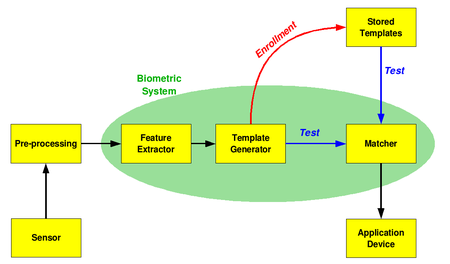
The basic block diagram of a biometric system
The diagram on right shows a simple block diagram of a biometric system. When such a system is networked together with telecommunications technology, biometric systems become telebiometric systems. The main operations a system can perform are enrollment and test. During the enrollment, biometric information from an individual is stored. During the test, biometric information is detected and compared with the stored information. Note that it is crucial that storage and retrieval of such systems themselves be secure if the biometric system is be robust. The first block (sensor) is the interface between the real world and our system; it has to acquire all the necessary data. Most of the times it is an image acquisition system, but it can change according to the characteristics desired. The second block performs all the necessary pre-processing: it has to remove artifacts from the sensor, to enhance the input (e.g. removing background noise), to use some kind of normalisation, etc. In the third block features needed are extracted. This step is an important step as the correct features need to be extracted and the optimal way. A vector of numbers or an image with particular properties is used to create a template. A template is a synthesis of all the characteristics extracted from the source, in the optimal size to allow for adequate identifiability.
If enrollment is being performed the template is simply stored somewhere (on a card or within a database or both). If a matching phase is being performed, the obtained template is passed to a matcher that compares it with other existing templates, estimating the distance between them using any algorithm (e.g. Hamming distance). The matching programme will analyse the template with the input. This will then be output for any specified use or purpose (e.g. entrance in a restricted area).
Functions
A biometric system can provide the following two functions :
- Verification does the template match the input sample? A pre-stored template is matched against a sample directly, e.g a card or known database entry.
- Identification what is the input sample? identifying from all the templates which one is the closest match to the input sample.
Performance measurement
- false accept rate (FAR) or false match rate (FMR): the probability that the system incorrectly declares a successful match between the input pattern and a non-matching pattern in the database. It measures the percent of invalid matches. These systems are critical since they are commonly used to forbid certain actions by disallowed people.
- false reject rate (FRR) or false non-match rate (FNMR): the probability that the system incorrectly declares failure of match between the input pattern and the matching template in the database. It measures the percent of valid inputs being rejected.
- receiver (or relative) operating characteristic (ROC): In general, the matching algorithm performs a decision using some parameters (e.g. a threshold). In biometric systems the FAR and FRR can typically be traded off against each other by changing those parameters. The ROC plot is obtained by graphing the values of FAR and FRR, changing the variables implicitly. A common variation is the Detection error trade-off (DET), which is obtained using normal deviate scales on both axes. This more linear graph illuminates the differences for higher performances (rarer errors).
- equal error rate (EER): the rate at which both accept and reject errors are equal. ROC or DET plotting is used because how FAR and FRR can be changed, is shown clearly. When quick comparison of two systems is required, the ERR is commonly used. Obtained from the ROC plot by taking the point where FAR and FRR have the same value. The lower the EER, the more accurate the system is considered to be.
- failure to enroll rate (FTE or FER): the percentage of data input is considered invalid and fails to input into the system. Failure to enroll happens when the data obtained by the sensor are considered invalid or of poor quality.
- failure to capture rate (FTC): Within automatic systems, the probability that the system fails to detect a biometric characteristic when presented correctly.
- template capacity: the maximum number of sets of data which can be input in to the system.
Performance
The following table shows the state of art of some biometric systems:
State of art of biometric recognition systems | Biometrics | EER | FAR | FRR | Subjects | Comment | Reference |
| Face | n.a. | 1 % | 10 % | 37437 | Varied lighting, indoor/outdoor | FRVT (2002)[4] |
| Fingerprint | n.a. | 1 % | 0.1 % | 25000 | US Government operational data | FpVTE (2003)[5] |
| Fingerprint | 2 % | 2 % | 2 % | 100 | Rotation and exaggerated skin distortion | FVC (2004)[6] |
| Hand geometry | 1 % | 2 % | 0.1 % | 129 | With rings and improper placement | (2005)[7] |
| Iris | <> | 0.94 % | 0.99 % | 1224 | Indoor environment | ITIRT (2005)[8] |
| Iris | 0.01 % | 0.0001 % | 0.2 % | 132 | Best conditions | NIST (2005)[9] |
| Keystrokes | 1.8 % | 7 % | 0.1 % | 15 | During 6 months period | (2005)[10] |
| Voice | 6 % | 2 % | 10 % | 310 | Text independent, multilingual | NIST (2004)[11] |
One simple but artificial way to judge a system is by EER, but not all the authors provided it. Moreover, there are two particular values of FAR and FRR to show how one parameter can change depending on the other. For fingerprint there are two different results, the one from 2003 is older but it was performed on a huge set of people, while in 2004 much less people were involved but stricter conditions have been applied. For iris, both references belong to the same year, but one was performed on more people, the other one is the result of a competition between several universities so, even if the sample is much smaller, it could reflect better the state of art of the field.
Issues and concerns
As with many interesting and powerful developments of technology, there are concerns about biometrics. The biggest concern is the fact that once a fingerprint or other biometric source has been compromised it is compromised for life, because users can never change their fingerprints. A theoretical example is a debit card with a personal Identification Number (PIN) or a biometric. Some argue that if a person's biometric data is stolen it might allow someone else to access personal information or financial accounts, in which case the damage could be irreversible. However, this argument ignores a key operational factor intrinsic to all biometrics-based security solutions: biometric solutions are based on matching, at the point of transaction, the information obtained by the scan of a "live" biometric sample to a pre-stored, static "match template" created when the user originally enrolled in the security system. Most of the commercially available biometric systems address the issues of ensuring that the static enrollment sample has not been tampered with (for example, by using hash codes and encryption), so the problem is effectively limited to cases where the scanned "live" biometric data is hacked. Even then, most competently designed solutions contain anti-hacking routines. For example, the scanned "live" image is virtually never the same from scan to scan owing to the inherent plasticity of biometrics; so, ironically, a "replay" attack using the stored biometric is easily detected because it is too perfect a match.
The television program Mythbusters attempted to break into a commercial security door equipped with biometric authentication as well as a personal laptop so equipped. While the laptop's system proved more difficult to bypass, the advanced commercial security door with "live" sensing was fooled with a printed scan of a fingerprint after it had been licked. Assuming the tested security door is representative of the current typical state of biometric authentication, that it was so easily bypassed suggests biometrics may not yet be reliable as a strong form of authentication.
Marketing of biometric products
Despite confirmed cases of defeating commercially available biometric scanners, many companies marketing biometric products (especially consumer-level products such as readers built into keyboards) still claim the products as replacements, rather than supplements, for passwords. Furthermore, regulations regarding advertising and manufacturing of biometric products are (as of 2006) largely non-existent. Given the low security, consumer-level products are most likely to be bought and used by most people, leading to the risk of large-scale economic and social problems associated with biometric identity theft.[citation needed]
Sociological concerns
As technology advances, and time goes on, more and more private companies and public utilities will use biometrics for safe, accurate identification. However, these advances will raise many concerns throughout society, where many may not be educated on the methods. Here are some examples of concerns society has with biometrics:
- Physical - Some believe this technology can cause physical harm to an individual using the methods, or that instruments used are unsanitary. For example, there are concerns that retina scanners might not always be clean.
- Personal Information - There are concerns whether our personal information taken through biometric methods can be misused, tampered with, or sold, e.g. by criminals stealing, rearranging or copying the biometric data. Also, the data obtained using biometrics can be used in unauthorized ways without the individual's consent.
Danger to owners of secured items
When thieves cannot get access to secure properties, there is a chance that the thieves will stalk and assault the property owner to gain access. If the item is secured with a biometric device, the damage to the owner could be irreversible, and potentially cost more than the secured property. In 2005, Malaysian car thieves cut off the finger of a Mercedes-Benz S-Class owner when attempting to steal the car.
Uses and initiatives
Brazil
Since the beginning of the 20th century, Brazilian citizens have user ID cards. The decision by the Brazilian government to adopt fingerprint-based biometrics was spearheaded by Dr. Felix Pacheco at Rio de Janeiro, at that time capital of the Federative Republic. Dr. Pacheco was a friend of Dr. Juan Vucetich, who invented one of the most complete tenprint classification systems in existence. The Vucetich system was adopted not only in Brazil, but also by most of the other South American countries. The oldest and most traditional ID Institute in Brazil (Instituto de Identificação Félix Pacheco) was integrated at DETRAN (Brazilian equivalent to DMV) into the civil and criminal AFIS system in 1999.
Each state in Brazil is allowed to print its own ID card, but the layout and data are the same for all of them. The ID cards printed in Rio de Janeiro are fully digitized using a 2D bar code with information which can be matched against its owner off-line. The 2D bar code encodes a color photo, a signature, two fingerprints, and other citizen data. This technology was developed in 2000 in order to enhance the safety of the Brazilian ID cards.
By the end of 2005, the Brazilian government started the development of its new passport. The new documents started to be released by the beginning of 2007, at Brasilia-DC. The new passport included several security features, like Laser perforation, UV hidden symbols, security layer over variable data and etc.. Brazilian citizens will have their signature, photo, and 10 rolled fingerprints collected during passport requests. All of the data is planned to be stored in ICAO E-passport standard. This allows for contactless electronic reading of the passport content and Citizens ID verification since fingerprint templates and token facial images will be available for automatic recognition.
United States
The United States government has become a strong advocate of biometrics with the increase in security concerns in recent years, since September 11, 2001. Starting in 2005, US passports with facial (image-based) biometric data were scheduled to be produced. Privacy activists in many countries have criticized the technology's use for the potential harm to civil liberties, privacy, and the risk of identity theft. Currently, there is some apprehension in the United States (and the European Union) that the information can be "skimmed" and identify people's citizenship remotely for criminal intent, such as kidnapping. There also are technical difficulties currently delaying biometric integration into passports in the United States, the United Kingdom, and the rest of the EU. These difficulties include compatibility of reading devices, information formatting, and nature of content (e.g. the US currently expect to use only image data, whereas the EU intends to use fingerprint and image data in their passport RFID biometric chip(s)).
The speech made by President Bush on May 15, 2006, live from the Oval Office, was very clear: from now on, anyone willing to go legally in the United States in order to work there will be card-indexed and will have to communicate his fingerprints while entering the country. Many foreigners will have to subject themselves to these procedures, formerly only imposed to criminals and to spies, not to immigrants and visitors, and even less to citizens.
"A key part of that system [for verifying documents and work eligibility of aliens] should be a new identification card for every legal foreign worker. This card should use biometric technology, such as digital fingerprints, to make it tamper-proof." President George W Bush (Addresses on Immigration Reform, May 15, 2006)
The US Department of Defense (DoD) Common Access Card, is an ID card issued to all US Service personnel and contractors on US Military sites. This card contains biometric data and digitized photographs. It also has laser-etched photographs and holograms to add security and reduce the risk of falsification. There have been over 10 million of these cards issued.
According to Jim Wayman, director of the National Biometric Test Center at San Jose State University, Walt Disney World is the nation's largest single commercial application of biometrics.However, the US Visit program will very soon surpass Walt Disney World for biometrics deployment.
Germany
The biometrics market in Germany will experience enormous growth until 2009. “The market size will increase from approximately 12 million € (2004) to 377 million €” (2009). “The federal government will be a major contributor to this development” . In particular, the biometric procedures of fingerprint and facial recognition can profit from the government project . In May 2005 the German Upper House of Parliament approved the implementation of the ePass, a passport issued to all German citizens which contain biometric technology. The ePass has been in circulation since November 2005, and contains a chip that initially will hold a digital photo of the holder's face. “Starting in March 2007, fingerprints also will be stored on the chips – one from each hand” . “A third biometric identifier – iris scans – could be added at a later stage” . An increase in the prevalence of biometric technology in Germany is an effort to not only keep citizens safe within German borders but also to comply with the current US deadline for visa-waiver countries to introduce biometric passports . In addition to producing biometric passports for German citizens, the German government has put in place new requirements for visitors for apply for visas within the country. “Only applicants for long-term visas, which allow more than three months' residence, will be affected by the planned biometric registration program. The new work visas will also include fingerprinting, iris scanning, and digital photos” .
Germany is also one of the first countries to implement biometric technology at the Olympic Games to protect German athletes. “The Olympic Games is always a diplomatically tense affair and previous events have been rocked by terrorist attacks - most notably when Germany last held the Games in Munich in 1972 and 11 Israeli athletes were killed” .
Biometric technology was first used at the Olympic Summer Games in Athens, Greece in 2004. “On registering with the scheme, accredited visitors will receive an ID card containing their fingerprint biometrics data that will enable them to access the 'German House'. Accredited visitors will include athletes, coaching staff, team management and members of the media” .
Australia
Visitors intending to visit Australia may soon have to submit to biometric authentication as part of the Smartgate system, linking individuals to their visas and passports. Biometric data are already collected from some visa applicants by Immigration. Other applications include authentication of gym users etc.
Israel
Biometrics have been used extensively in Israel for several years. [citation needed]
The border crossing points from Israel to the Gaza Strip and West Bank are controlled by gates through which authorised Palestinians may pass. Thousands of Palestinians (upwards of 90,000) pass through the turnstiles every day to work in Israel, and each of them has an ID card which has been issued by the Israeli Military at the registration centres. At peak periods more than 15,000 people an hour pass through the gates. The ID card is a smartcard with stored biometrics of fingerprints, facial geometry and hand geometry. In addition there is a photograph printed on the card and a digital version stored on the smartcard chip. [citation needed]
Tel Aviv Ben Gurion Airport has a frequent flyer's fast check-in system which is based on the use of a smartcard which holds information relating to the holders hand geometry and fingerprints. For a traveller to pass through the fast path using the smartcard system takes less than 10 seconds. [citation needed]
The Immigration Police at Tel Aviv Airport use a system of registration for foreign workers that utilises fingerprint, photograph and facial geometry which is stored against the Passport details of the individual. There is a mobile version of this which allows the police to check on an individual's credentials at any time. [citation needed]
Iraq
Biometrics are being used extensively in Iraq to catalogue as many Iraqis as possible providing Iraqis with a verifiable identification card, immune to forgery. During account creation, the collected biometrics information is logged into a central database which then allows a user profile to be created. Even if an Iraqi has lost their ID card, their identification can be found and verified by using their unique biometric information. Additional information can also be added to each account record, such as individual personal history. This can help American forces determine whether someone has been causing trouble in the past. One major system in use in Iraq is called BISA. This system uses a smartcard and a users biometrics (fingerpint, iris, and face photos) to ensure they are authorized access to a base or facility.
Japan
Several banks in Japan have adopted palm vein authentication technology on their ATMs. This technology which was developed by Fujitsu, among other companies, proved to have low false rejection rate (around 0.01%) and a very low false acceptance rate (less than 0.00008%).